
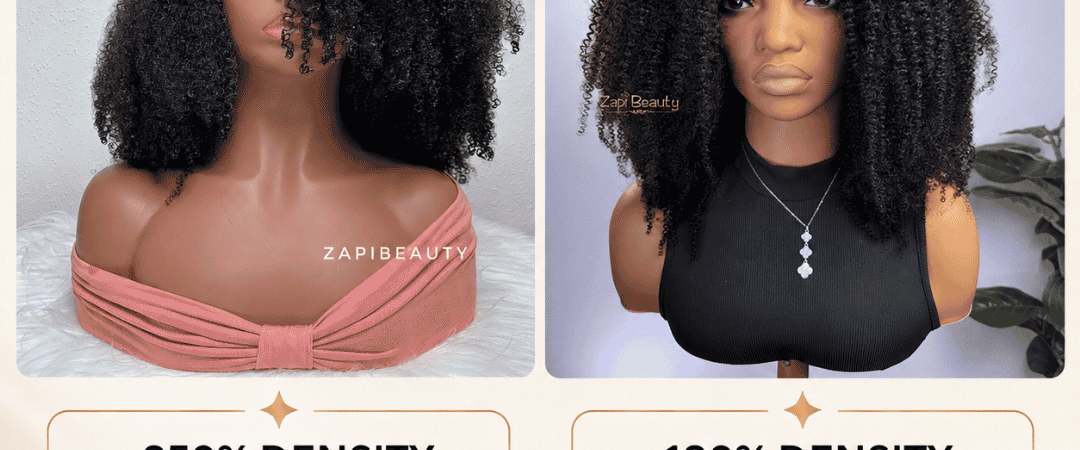
You found the right texture.
You chose your length.
Then you reach the density option:
180% or 250%?
And suddenly you’re wondering whether 180% will look too thin — or whether 250% will look like entirely too much hair.
Here is the first thing to know:
Higher density does not mean higher quality.
Density simply describes how full the wig is intended to be. In general, 180% gives a full but more moderate appearance, while 250% gives considerably more volume. Density percentages are also not perfectly standardized across manufacturers, so one company’s 180% may not look identical to another company’s 180%.
And with curly, kinky-curly and coily hair?
The answer becomes even more interesting.
Because texture changes how density looks.
First, What Does Wig Density Mean?
Wig density refers to the amount of hair distributed across the wig cap.
Think of it as fullness, not strand thickness.
A 250% density wig doesn’t necessarily have thicker individual strands than a 180% wig.
It simply contains more hair.
This is also different from:
Length — how long the strands are.
Cap size — how the wig fits your head.
Hair quality — whether the hair itself is good quality.
Texture — whether the hair is straight, curly, coily or kinky.
Density tells you primarily how full the finished wig will appear.
What Does 180% Density Look Like?
A 180% density wig sits in the fuller range without automatically creating maximum volume.
For many styles, it provides enough hair to look healthy and full while still giving the wig movement.
Current wig-density guides generally position 180% as a middle ground between lighter everyday densities and very high densities such as 250%.
But don’t interpret that as:
180% = thin.
It isn’t.
Especially not with textured hair.
A 180% kinky-curly wig can appear significantly fuller than a 180% straight wig because curls and coils occupy more visual space. Industry guides similarly note that curl pattern, length and hair distribution can make two wigs with the same stated density appear very different.
For a Zapi Beauty customer who wants realistic volume without extremely large hair, 180% can be a beautiful starting point.
What Does 250% Density Look Like?
Now imagine taking that fullness considerably further.
A 250% density wig contains substantially more hair and is designed to create a much fuller silhouette.
This is the option for someone who genuinely enjoys:
big hair
dense curls
substantial volume
very full ends
or a stronger statement look.
Current density guides generally describe 250% as a high-volume option and note that it can also involve more weight, drying time and maintenance than moderate densities.
But here’s an important point:
250% does not automatically look unnatural.
That depends heavily on the texture and the woman wearing it.
A woman whose own natural hair is extremely dense may feel completely at home in a very full kinky-coily wig.
Someone who naturally has finer, lower-density hair may feel overwhelmed by exactly the same wig.
Natural-looking doesn’t mean one universal amount of hair.
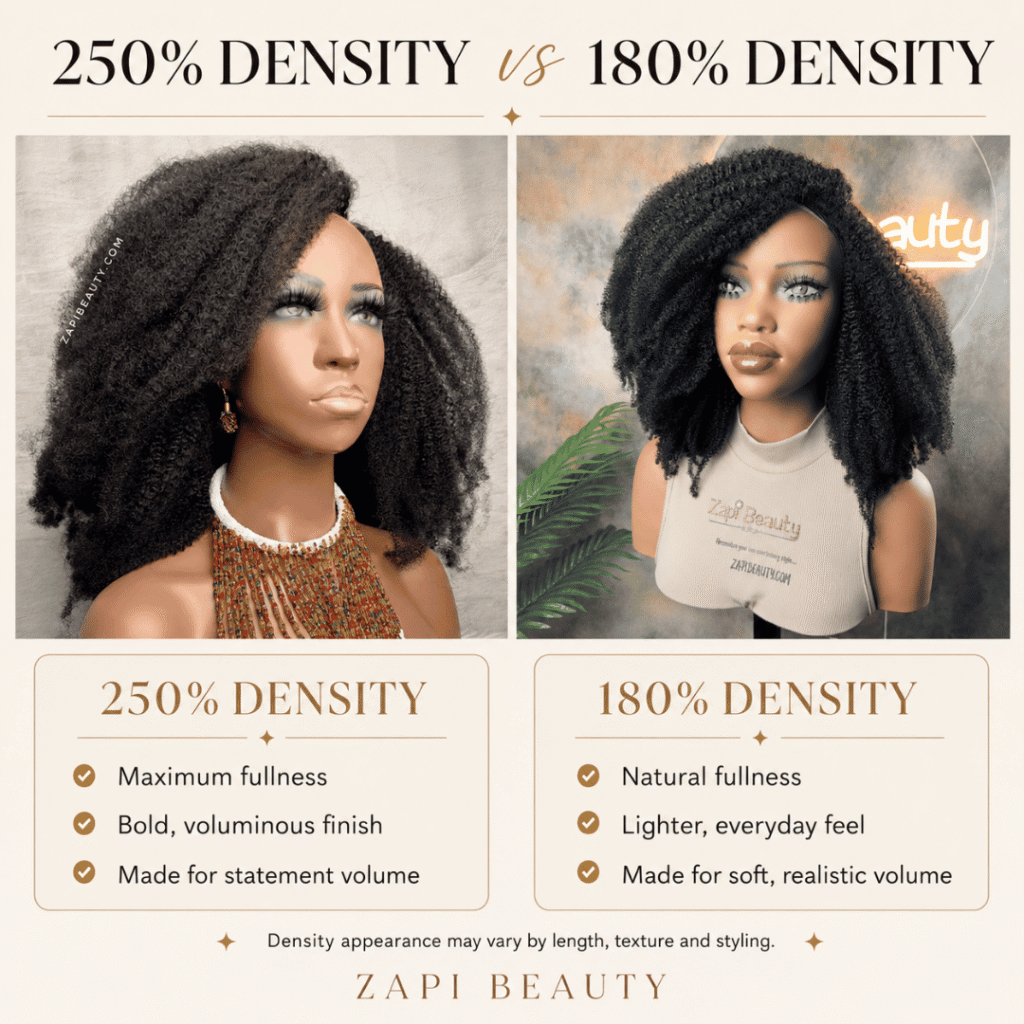
180% vs 250% Wig Density at a Glance
| 180% Density | 250% Density | |
|---|---|---|
| Overall fullness | Full | Very full |
| Visual volume | Balanced | High |
| Weight | Generally lighter | Generally heavier |
| Drying time | Usually shorter | Usually longer |
| Detangling | Less hair to manage | More hair to manage |
| Best for | Everyday fullness | Maximum volume |
| Long lengths | Full without excessive bulk | Very dense through length |
| Curly/coily textures | Can already appear quite voluminous | Can become extremely full |
| Natural look | Often easier for moderate fullness | Can look natural on naturally dense hair |
| Styling personality | Soft, full, wearable | Bold, abundant, statement-making |
That is the practical difference.
Not:
cheap vs premium.
Not:
bad vs good.
Just different amounts of hair.
Here’s Where Texture Changes Everything
This is probably the most important section of this entire article.
Imagine three 180% wigs:
one bone straight,
one kinky straight,
and one tightly coiled.
They’re all labeled 180% density.
Will they look equally full?
No.
The straight strands lie closer together.
The kinky-straight hair expands.
The coily hair expands even more because every bend creates additional visual space.
That is why choosing wig density for curly hair based entirely on photos of straight wigs can be misleading.
Curly and coily textures often look fuller at the same density because their shape occupies more space.
So when a Zapi Beauty customer asks:
“Is 180% enough?”
My next question would be:
“In which texture?”
180% Density on Kinky-Coily Hair
Let’s imagine a shorter or medium-length kinky-coily wig.
At 180%, you can already have:
strong volume
a rounded natural shape
full curls
and substantial texture.
Once the curls are separated and fluffed, the wig may appear considerably larger than it did when wet or freshly defined.
This is why 180% can be more than enough for someone who wants a textured wig that looks like naturally full hair rather than deliberately oversized hair.
It can also be easier to manage.
Less hair means less hair to:
wash
condition
detangle
dry
and restyle.
That practicality matters.
What Does 250% Look Like in Coily Hair?
Now take the same coily texture and add substantially more hair.
You’re no longer simply adding a little fullness.
You’re creating volume on top of volume.
For the woman who loves big natural hair?
Beautiful.
For the woman who wants a conservative everyday shape?
Probably unnecessary.
A 250% coily wig can produce a very rich, dense silhouette, especially when the curls are separated and fully dry.
So before ordering it because “more hair sounds better,” ask yourself whether you genuinely enjoy managing very full textured hair.
Because you’re not just buying more visual volume.
You’re also buying more hair to maintain.
Don’t Choose 250% Just Because It Costs More
This is an easy shopping mistake.
A higher-density wig usually contains more hair.
More hair may increase the price.
The customer sees the higher price and assumes:
“That must be the premium one.”
Not necessarily.
A beautifully constructed 180% wig made from excellent hair can be far superior to a poorly made 250% wig.
Density itself is not a quality grade. Supplier and wholesale guidance explicitly separates density from hair quality and notes that the percentage should not be treated as a standalone measure of how good the wig is.
So don’t buy 250% because you think you’re upgrading the quality.
Choose it because you actually want the additional fullness.
Length Changes the Decision Too
Density and length work together.
Picture 180% density at:
12 inches
18 inches
and 26 inches.
The experience won’t be identical.
Longer hair can visually appear less concentrated because the strands are distributed over more length, while shorter textured hair can appear extremely full because all of that volume is concentrated closer to the head. Wig-industry guidance similarly notes that length affects how a given density appears.
That means someone ordering a very long wig may prefer additional density to maintain fuller-looking ends.
But with a shorter kinky-curly wig?
You may already have all the volume you need at 180%.
Think About the Ends, Not Just the Crown
This is something shoppers often miss.
When looking at a density comparison, don’t only look at the top of the wig.
Look at the bottom half.
Does the hair become noticeably thin toward the ends?
Do you want airy ends?
Or do you prefer a thick, abundant finish from root to tip?
A fuller density can help create more visual weight through longer lengths.
But again, hair construction matters.
A well-made wig with thoughtfully distributed hair can sometimes look fuller through the ends than another wig carrying the same density label.
This is another reason density percentages should be treated as a guide rather than a perfectly standardized measurement.
Your Head Size Matters More Than People Realize
Here is something you rarely hear in density comparisons.
Two women can buy the same density and have different experiences because their cap sizes are different.
Density is distributed over the wig cap.
A petite cap and a large cap do not have exactly the same surface area.
That’s another reason simply reading “180%” doesn’t tell you everything you need to know about the final wig.
Fit and density should be considered together.
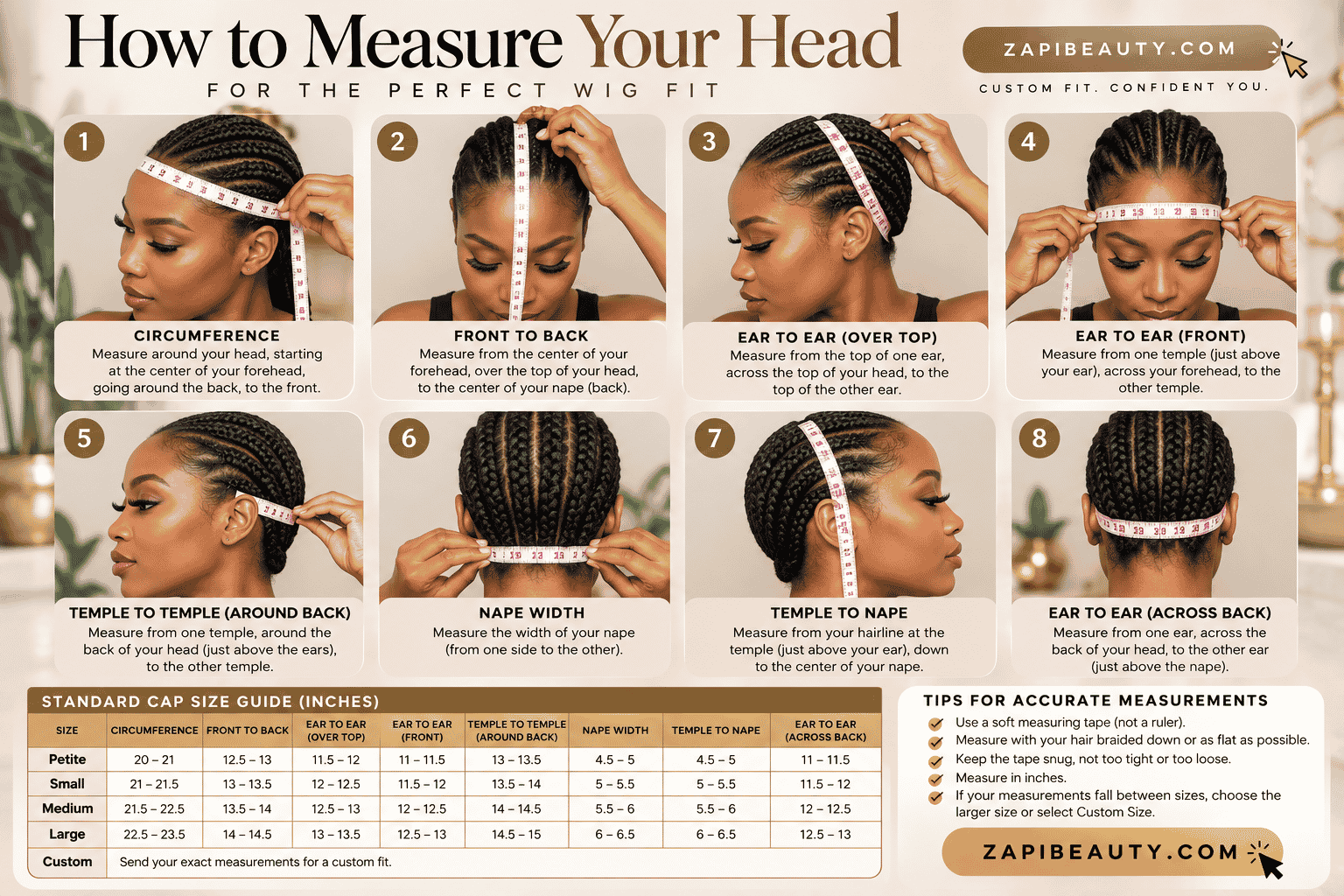
And that’s exactly why our next Zapi Beauty guide will cover custom wig cap sizes and how to properly measure your head.
Custom Wig Cap Sizes Explained
Your Natural Hair Density Is a Better Guide Than Trends
Put TikTok aside for a minute.
Look at your own hair.
When your natural hair is fully grown out and styled, would you describe it as:
light?
medium?
very full?
extremely dense?
If your goal is a wig that genuinely resembles what your own hair could look like with more length, your natural density is useful information.
If your natural hair is moderate in density:
180% may feel more familiar.
If your natural hair is extremely dense:
250% might actually look perfectly believable on you.
If you simply love big hair:
Forget what your biological density is.
Choose the fullness you enjoy.
Natural-looking and understated are not always the same thing.
Don’t Forget Your Face and Frame
Hair exists around your face.
It isn’t floating by itself.
Very full hair can beautifully balance some people and completely overwhelm others.
Look at:
your face size
your shoulder width
your height
the length of the wig
and how much hair you personally enjoy seeing around your face.
This doesn’t mean there are rigid rules.
There aren’t.
It simply means the same 250% wig can feel completely different on two women.
What Density Is Best for Everyday Wear?
For someone who wants:
easy movement
substantial fullness
less weight
and a more manageable routine,
180% is often the more practical everyday option.
Current wig guides commonly place 180% in that fuller-but-wearable category.
That doesn’t mean everyone should choose it.
But if you’re buying your first high-density textured wig and have no idea whether you’ll enjoy very large hair, I would be cautious about automatically jumping to 250%.
More isn’t automatically better.
When 250% Makes Sense
Choose 250% density because you deliberately want it.
It makes sense when you love:
very full curls
dramatic volume
dense long hair
fuller styling
statement hair for photography or special events
or simply that luxurious abundance of having a lot of hair.
There is nothing wrong with wanting that.
Just know what you’re buying.
The Maintenance Difference Is Real
Suppose you’re choosing between two 24-inch curly wigs.
One is 180%.
The other is 250%.
The 250% wig doesn’t only look fuller.
There is physically more hair for you to care for.
That can mean:
more sections when detangling
more conditioner
longer drying time
more time redefining curls
more hair at the nape
and potentially more weight on the head.
Higher-density wig guides consistently identify increased maintenance and weight as tradeoffs of very full densities.
For some women, that’s worth every second.
For others?
The wig ends up sitting in the closet because it’s too much work.
Choose for your actual lifestyle.
If You Have a Small Head
This deserves special attention.
If you have a petite head and prefer a refined natural look, extremely high density can sometimes feel like the hair is wearing you.
A well-fitted 180% wig may give you plenty of fullness without creating unnecessary bulk.
But if you’re petite and absolutely love huge hair?
Wear your 250%.
The point isn’t creating another rigid beauty rule.
It’s understanding what the number means before you spend your money.
If You Want a Natural-Looking 4C Wig
This is where I wouldn’t automatically choose the lower density.
Natural 4C hair can be extraordinarily dense.
So a fuller wig can still look completely believable.
Instead, look at:
curl size
overall silhouette
length
your natural hair density
and how much volume you normally wear.
For some women, 180% will look like a realistic full head of coily hair.
For another woman, 250% may resemble her natural density more closely.
This is why I don’t like saying:
“180% is natural, 250% is unnatural.”
That’s too simplistic.
Wet Curly Hair Will Fool You
If you’re looking at product images of curly wigs, pay attention to whether the hair is wet.
Wet curly hair contracts visually.
It becomes:
more defined
less wide
and often flatter.
Once it dries and is separated, it can become dramatically fuller.
A 250% kinky-curly wig that looks manageable when soaking wet may become very large hair after it is completely dry and fluffed.
Always look for dry photos when possible.
This is particularly important with coily textures.
180% vs 250% Density: Choose Based on These 5 Questions
Instead of asking “Which one is better?”, ask:
1. How much hair do I actually like?
If you constantly add bundles because hair never feels full enough, you probably already know your answer.
2. What texture am I buying?
The tighter and more expansive the texture, the fuller a given density may appear.
3. How long is the wig?
Longer hair may benefit from more fullness if you dislike thinner-looking ends.
4. How much maintenance am I willing to do?
More hair means more hair.
There is no shortcut around that.
5. What look am I trying to create?
Soft everyday fullness?
Or abundant, statement-making volume?
Answer those five questions and choosing density becomes much easier.
So, Which Looks More Natural: 180% or 250%?
There is no universal winner.
180% generally gives a fuller but more restrained result and will suit many women looking for everyday fullness.
250% gives considerably more hair and works better for women who want abundant volume or naturally have very dense hair.
And with curly and coily textures, the curl pattern itself makes the wig look fuller, so density should never be considered separately from texture.
The right density is the one that looks believable for the look you are trying to create.
Frequently Asked Questions
What does 180% density mean in a wig?
It describes a relatively full amount of hair distributed across the wig cap. It is generally considered fuller than lighter everyday densities while remaining more moderate than very high densities such as 250%.
Is 180% density thick?
Yes. 180% is not a low-density wig. How thick it appears depends on the texture, length, construction and how the hair is distributed.
Is 250% density too much?
Not necessarily. It is a very full density, but whether it feels excessive depends on your texture, desired style, natural density and personal preference.
Does 250% density mean better hair?
No. Density measures fullness, not hair quality.
Is 180% or 250% better for curly hair?
Curly hair already creates additional visual volume, so 180% can appear very full. Choose 250% if you specifically want substantially more volume.
What wig density looks most natural?
There is no single density that looks natural on everyone. Texture, length, cap construction, head size and your own natural hair density all influence the finished appearance. Also, density percentages are not perfectly standardized between manufacturers.
Is 250% density heavier?
Generally, yes. More hair usually means greater weight and more maintenance compared with a lower-density version of a similar wig.
More Hair Isn’t Always a Better Wig
This is the decision I want you to make differently.
Don’t choose 250% because it sounds more luxurious.
And don’t choose 180% simply because somebody told you it’s more natural.
Look at the texture.
Look at the length.
Look at your own hair.
Think about how much maintenance you’re actually willing to do.
Then choose the amount of hair that creates the look you want.
At Zapi Beauty, our textured wigs are available in different fullness options because Black women don’t all have the same natural density — and we shouldn’t have to.
Some of us want soft, believable fullness.
Some of us want hair that enters the room with us.
Both can be beautiful.