
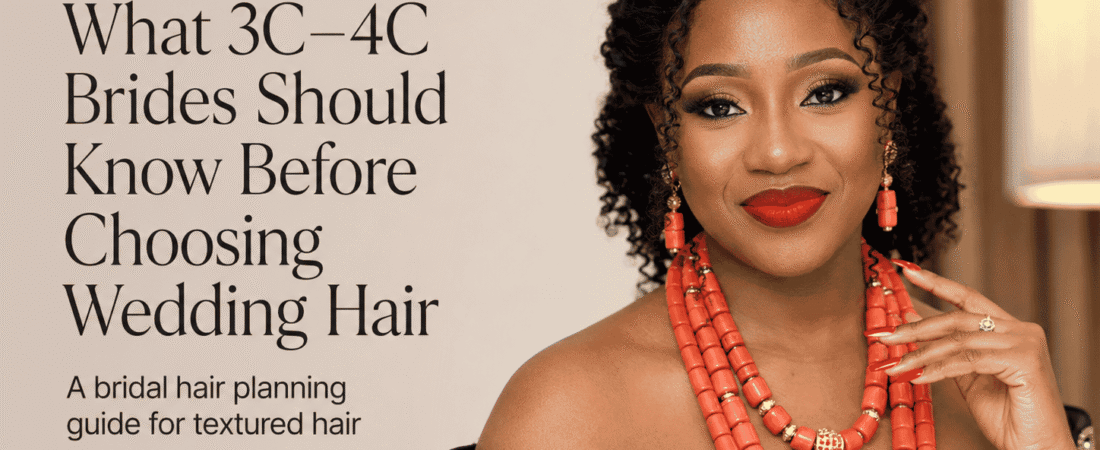
A bridal hair planning guide for textured hair brides who want beauty, comfort, and confidence
Choosing your wedding hair is not something to leave until the last minute.
Especially if you are a bride with 3C, 4A, 4B, or 4C hair.
Your wedding hair is not just about finding a pretty hairstyle on Pinterest. It is about choosing a look that works with your real texture, your dress, your veil, your weather, your comfort, your photos, your face, your culture, and your confidence.
For textured hair brides, bridal hair needs planning.
Because your hair may shrink.
Your leave-out may change during the day.
Your curls may react to humidity.
Your wig may need the right cap size.
Your veil may need special placement.
Your style may need extra security.
Your hairpiece may need to match your real texture.
Your accessories may need to be tested before the wedding day.
And if you are a Nigerian bride, an Edo bride, a traditional bride, or a bride doing both white wedding and traditional wedding looks, your bridal hair has even more responsibility. It must hold beauty, culture, elegance, and comfort at the same time.
Your wedding hair should not just look beautiful for five minutes.
It should carry you through the day.
It should stay secure during pictures, hugs, dancing, prayers, ceremony, reception, outfit changes, and every emotional moment in between.
That is why this guide is important.
Before choosing your bridal hair, here is what every 3C–4C bride should know.
1. Your Bridal Hair Should Match Your Texture, Not Fight It
This is the first thing.
Your wedding day is not the day to force your hair into a texture that does not feel like you.
If you have 3C curls, 4A coils, 4B fluffy texture, or 4C tight shrinkage, your bridal hair should be chosen with that in mind.
That does not mean you can only wear hair that looks exactly like your natural hair. You can wear kinky curly, coily, afro kinky, kinky straight, a bridal ponytail, a half wig, clip-ins, a custom wig, or even a polished stretched style.
But the hair should still make sense with you.
A common mistake textured brides make is choosing overly silky hair because they think that is what “bridal” means. But silky hair can look disconnected from natural roots, textured leave-out, or a bride whose beauty naturally carries more volume and fullness.
Bridal does not have to mean silky.
Bridal can be kinky curly.
Bridal can be coily.
Bridal can be full.
Bridal can be natural-looking.
Bridal can be textured.
Bridal can be soft and romantic without being straight.
Your texture is not something to hide before you become bridal.
Your texture can be the reason the look is beautiful.
2. Decide Early If You Want Leave-Out or No Leave-Out
This decision affects everything.
If you want leave-out, the bridal hair must blend with your natural texture. If the wig, clip-ins, half wig, or ponytail does not match your leave-out, the style may look disconnected.
For 3C–4C brides, leave-out can be beautiful, but it must be realistic.
Ask yourself:
Will my leave-out blend with this hair texture?
Will it stay blended after hours of photos and dancing?
Will humidity affect it?
Will I need heat to make it match?
Will I be comfortable maintaining it during the day?
Will it still look good after my veil is removed?
If your leave-out needs too much heat, gel, stretching, or manipulation to blend, you may want to consider a no leave-out option.
No leave-out options can include:
Fake scalp wigs
Bang wigs
Closure wigs
Kinky curly half wigs with textured hairline illusion
Headband styles
Drawstring ponytails
Custom bridal wigs
Full protective bridal styles
No leave-out does not mean fake.
It simply means your natural hair is protected and the style is designed to look complete without exposing your hairline or roots.
For many brides, no leave-out is actually the more peaceful choice.
3. Your Wedding Weather Matters
Weather can change everything.
This is especially important for outdoor weddings, summer weddings, humid locations, tropical weddings, Nigerian weddings, Houston weddings, destination weddings, and traditional ceremonies where you may be moving, dancing, and wearing heavy accessories.
Heat and humidity can affect textured hair quickly.
Your hair may shrink.
Your roots may swell.
Your curls may expand.
Your leave-out may stop blending.
Your wig may feel warmer.
Your edges may soften.
Your curls may become bigger throughout the day.
This does not mean textured hair cannot survive a wedding day. It simply means the style needs to be planned wisely.
If the weather is humid, you may want:
A no leave-out style
A textured updo
A secure bridal ponytail
A half wig with minimal leave-out
A custom wig with proper cap fit
A style that still looks good with volume
A touch-up kit
A stylist or trusted helper for adjustments
Do not choose a bridal hairstyle that only works in perfect weather.
Choose a style that can still look beautiful when real life happens.
4. Your Veil Placement Must Be Planned Before the Wedding Day
Veil placement is not something to guess on the wedding morning.
For textured hair, the veil needs to work with volume, curls, coils, wig placement, pins, combs, accessories, and the shape of the hairstyle.
A veil can be placed:
Above the crown
Under a bun
Behind a half-up style
Under a textured ponytail
At the back of a wig
Under a bridal hairpiece
Behind coral beads or traditional accessories
If you are wearing a wig, the veil comb must be placed carefully so it does not pull the wig backward or shift the cap.
If you are wearing a half wig, the veil should not disturb the front blend.
If you are wearing a full curly style, the veil should not crush the curls.
If you are doing an Edo bridal look with coral beads, crown, or traditional accessories, the hair needs to support the weight and placement of those accessories.
That is why you should test your veil and hair accessories during your bridal hair trial.
Do not assume it will work.
Test it.
5. Your Hair Density Should Match the Bridal Look
Density means how full the hair is.
For bridal hair, density is important because the style must look beautiful in person and in photos.
Too little hair can look flat.
Too much hair can look bulky.
Too much volume around the face can hide your makeup.
Too little volume can make the style look unfinished.
The wrong density can make a wig look less natural.
For 3C–4C brides, density should be chosen based on the hairstyle, not just personal preference.
A kinky curly bridal wig may need enough density to look full and romantic.
A ponytail may need enough fullness to look elegant from the back.
Clip-ins should add volume without pulling on your scalp.
A half wig should match the fullness of your natural hairline or front blend.
An Edo bridal look may need enough structure to hold accessories beautifully.
Bridal hair should have shape.
It should not just be big for the sake of being big.
The fullness should flatter your face, dress, neckline, and overall bridal look.
6. Your Dress Neckline Should Influence Your Hairstyle
Your wedding hair should not be chosen separately from your dress.
The dress and hair should work together.
If your dress has a high neckline, a lifted style or updo may show the dress better.
If your dress is strapless, curls down or half-up styles can soften the shoulders.
If your dress has a detailed back, a low bun or side style may allow the back to show.
If your dress is heavily beaded, a simpler hairstyle may balance the look.
If your dress is simple, fuller textured hair can add drama.
For traditional Edo bridal attire, the neckline, beads, wrapper, coral accessories, and makeup all matter. The hair should not compete with the coral beads or cover the beauty of the traditional styling.
If you are wearing bold coral beads, dramatic earrings, smoky eyes, red lips, and a statement outfit, the hair should frame the face and support the look without overwhelming everything.
Your bridal hair is part of the full styling.
It should not fight your outfit.
7. Comfort Is Not Optional
Some brides choose hair only based on beauty and forget comfort.
That is a mistake.
Your wedding day can be long.
You may wear your hair for hours. You may take pictures before the ceremony. You may go through the ceremony, reception, family photos, dancing, outfit changes, and possibly a second look.
If your wig is too tight, you will feel it.
If the clips are pulling, you will feel it.
If the ponytail is too heavy, you will feel it.
If the pins are painful, you will feel it.
If the cap does not fit, you will feel it.
If the accessories are too heavy, you will feel it.
And discomfort shows on the face.
A beautiful hairstyle is not worth a headache on your wedding day.
This is why textured brides should pay attention to:
Cap size
Wig weight
Clip placement
Ponytail tension
Accessory weight
Scalp sensitivity
Edge protection
Breathability
Security without pain
Your bridal hair should feel secure, not painful.
8. A Bridal Hair Trial Is Necessary
A bridal hair trial is not extra.
It is protection.
This is where you test the look before the real day. You get to see if the style matches your face, dress idea, veil, accessories, hair texture, and comfort level.
During your bridal hair trial, you should test:
The texture
The density
The cap fit
The parting
The leave-out blend
The veil placement
The accessories
The front view
The side view
The back view
How the hair photographs
How comfortable the hair feels
How secure the style is
Take photos during the trial.
Do not only look in the mirror. Take pictures in natural light, indoor light, and with flash if possible.
Wedding hair must look good on camera.
A style can look nice in person but too shiny, too flat, or too bulky in photos. The trial helps you catch that before the wedding day.
9. Your Bridal Hair Should Work With Your Makeup
Hair and makeup must speak the same language.
For example, if you are wearing a soft bridal makeup look, your hair may be romantic, airy, and softly shaped.
If you are doing a Nigerian bridal look with bold lashes, smoky eyes, defined brows, red lips, coral beads, and rich traditional attire, your hair should support that drama.
For an Edo bride especially, red lips, smoky eyes, lashes, coral beads, and traditional styling create a powerful bridal look. The hair should frame the face beautifully so the makeup and accessories can shine.
A textured updo, kinky curly half-up style, soft bridal ponytail, or structured curls can all work beautifully depending on the outfit.
The mistake is choosing hair that hides the makeup or makes the face look too busy.
Your hair should make the makeup look better.
Not compete with it.
10. Your Cultural Look Deserves Respect
For Nigerian brides and Edo brides, bridal hair is not only fashion. It can be part of cultural beauty.
The coral beads, traditional fabric, makeup, accessories, and styling all carry meaning and presence.
So if you are doing a traditional wedding look, your hair should be planned with the full cultural outfit in mind.
An Edo bridal look may include:
Coral bead necklaces
Coral earrings
Coral bracelets
A crown or beaded headpiece
Rich traditional attire
Bold makeup
Red lips
Smoky eyes
Elegant nails
A regal posture
A hairstyle that supports the accessories
This kind of bridal look needs balance.
If the hair is too loose or too casual, it may not match the richness of the attire. If the hair is too bulky, it may fight the beads and headpiece. If the hair is too straight and disconnected from the bride’s identity, it may not feel personal.
A textured bridal style can look regal, traditional, and modern at the same time.
You do not have to abandon texture to look cultural or elegant.
11. Your Bridal Hair Should Be Secure
A wedding hairstyle should not only be beautiful.
It should be secure.
You will hug people.
You may dance.
You may bend.
You may turn your head.
You may remove your veil.
You may change outfits.
You may sweat.
You may take hundreds of pictures.
Your hair needs to stay in place.
For wigs, security can come from the right cap size, elastic band, combs, clips, pins, or custom construction.
For ponytails, the base must be firm but not painful.
For clip-ins, the clips must be placed where they add volume without pulling.
For half wigs, the front blend and back placement must be secure.
For Edo bridal accessories, the beads or headpiece must be positioned in a way that does not pull the hair out of place.
The goal is not stiffness.
The goal is security with comfort.
12. Do Not Wait Too Long to Order Custom Bridal Hair
If you want custom bridal hair, do not wait until the last minute.
Custom wigs, half wigs, clip-ins, ponytails, and bridal hair pieces may require time for consultation, texture matching, cap sizing, construction, adjustments, shipping, trial styling, and final preparation.
The closer you wait until the wedding, the fewer options you have.
A good bridal hair timeline may look like this:
Three to six months before the wedding: start researching and booking consultation.
Two to three months before: confirm texture, style, cap size, color, and bridal hair plan.
Four to six weeks before: receive or finalize the hair and schedule trial.
Two to three weeks before: make final adjustments.
Wedding week: prep, organize accessories, and confirm the final plan.
Do not treat bridal hair like a last-minute beauty purchase.
Treat it like part of your wedding styling.
Because it is.
13. Choose Hair That Still Feels Like You
This is the most important point.
Your wedding hair should not make you feel disconnected from yourself.
You should not look at your photos and feel like you wore someone else’s beauty.
If you love your curls, choose curls.
If you love fullness, choose volume.
If you love a polished look, choose kinky straight or a structured style.
If you want your hair protected, choose no leave-out.
If you want cultural elegance, choose a style that supports your traditional bridal look.
If you want softness, choose romantic texture.
You do not have to choose what everyone else chooses.
You have to choose what makes you feel beautiful, confident, comfortable, and present.
The right wedding hair should feel personal.
It should feel intentional.
It should feel like you.
Why Choose Zapi Beauty for Textured Bridal Hair
At Zapi Beauty, we understand that textured brides need more than a pretty hairstyle.
You need a bridal hair plan.
We help brides with 3C, 4A, 4B, and 4C textures choose natural-looking, comfortable, secure, and elegant hair solutions for weddings, bridal showers, engagement shoots, traditional weddings, courthouse weddings, receptions, and special events.
Whether you need a kinky curly bridal wig, a textured half wig, clip-in volume, a bridal ponytail, a U-part wig, a fake scalp bang wig, or a special custom bridal unit, the goal is to help you choose hair that works with your texture and your vision.
Your bridal hair should match your dress, veil, makeup, culture, comfort, and confidence.
It should not feel forced.
It should not feel disconnected.
It should not make you fight your natural texture.
It should help you show up beautifully.
Final Thoughts
Before choosing your wedding hair, slow down and think beyond the picture.
Think about texture.
Think about comfort.
Think about weather.
Think about veil placement.
Think about density.
Think about your dress.
Think about your makeup.
Think about your culture.
Think about your photos.
Think about how you want to feel.
Because your wedding hair is not just hair.
It is part of how you will remember yourself on one of the most important days of your life.
And if you have 3C, 4A, 4B, or 4C hair, your texture deserves to be included in that memory beautifully.
Your bridal hair should not erase you.
It should honor you.
Learn more about :
Zapi Bridal Hair Experience here>>
3c-4c texture guide blog here>>