
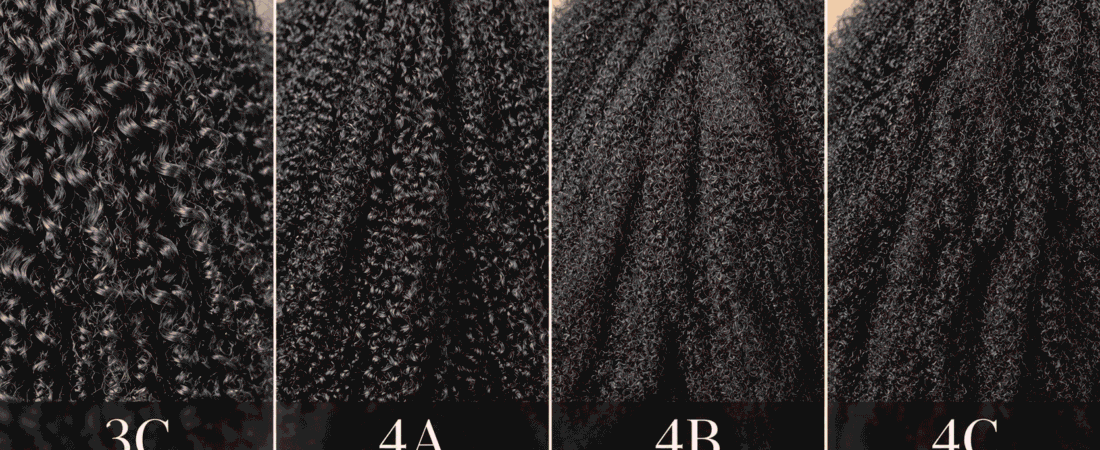
You look at one section of your hair and think:
“Definitely 4C.”
Then you look near your temples and suddenly the curls look more like 4A.
The back has its own plans entirely.
Welcome to natural hair.
One of the biggest mistakes women make when trying to identify their natural hair type is assuming every strand on their head has to fit neatly into one box.
It doesn’t.
You may have 3C and 4A hair, 4A and 4B, or even a combination of 4B and 4C hair on the same head.
And when you’re choosing a textured wig, knowing this actually matters.
Not because you need to pass a hair-type test.
But because understanding the general shape, size and appearance of your texture can help you choose a wig that blends with your natural hair instead of fighting against it.
So let’s make this simple.
First: Your Hair Type Is a Guide, Not Your Identity
Before we compare 3C vs 4A vs 4B vs 4C hair, there is something worth understanding.
Hair typing is a useful shorthand.
It is not a perfect science.
Different hair-typing systems don’t always classify curls exactly the same way, and even 3C does not appear in every version of the commonly used typing systems.
Your hair also has other characteristics that matter:
Density — how much hair grows on your head.
Strand thickness — whether individual strands are fine, medium or coarse.
Porosity — how your hair absorbs and retains moisture.
Shrinkage — how much shorter your hair appears when it contracts.
Styling state — whether your hair is freshly washed, stretched, twisted, brushed out or defined.
So when you’re looking for a wig texture, don’t become trapped by a letter and number.
We’re looking for a visual relationship between your hair and the extension hair.
The Quick Texture Guide
Here’s the simple version.
| Hair Type | General Appearance | When Choosing a Wig |
|---|---|---|
| 3C | Tight, defined corkscrew curls | Look for defined curly textures |
| 4A | Small, springy, visible coils | Look for defined kinky-curly/coily textures |
| 4B | Tighter bends and less uniform definition | Look for dense, fluffy kinky-coily textures |
| 4C | Very tight coils/kinks with significant shrinkage | Look for tight, full, highly textured coily hair |
3C is generally described as tightly packed corkscrew curls, while Type 4 hair moves into increasingly tight coily and kinky patterns. 4B is often described as having more angular or Z-like bends, while 4C tends to have very tight patterning and substantial shrinkage.
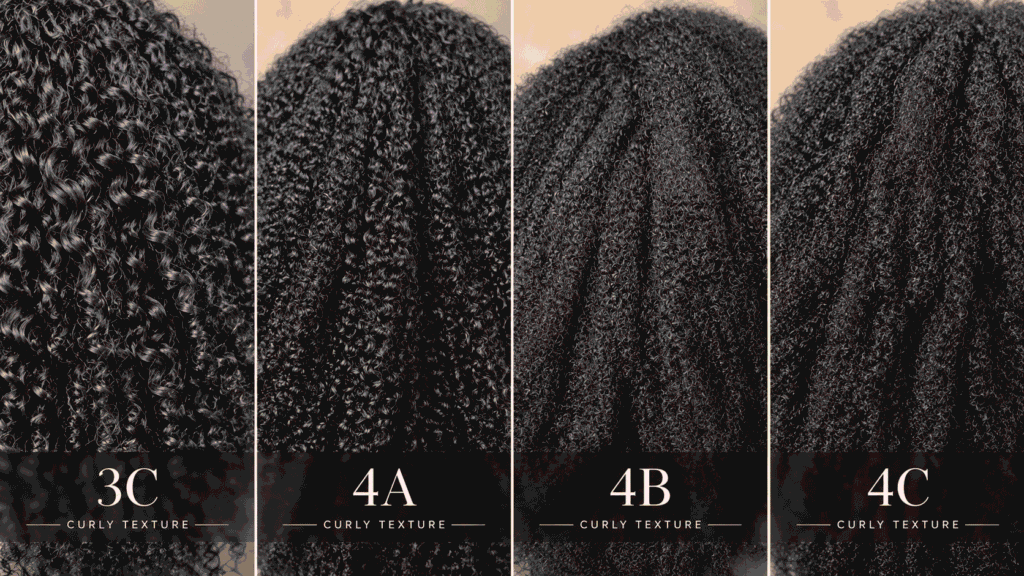
But pictures will always tell you more than a chart.
What Does 3C Hair Look Like?
Think small, springy corkscrew curls.
3C curls usually have visible definition even when there is a lot of volume.
You can often look at an individual section and clearly see the curl looping around itself.
The overall effect can be full and dense, but the individual curls remain relatively easy to identify.
If you have 3C natural hair…
When shopping for textured extensions or wigs, you may prefer something described as:
curly human hair
tight curly
kinky curly
or a defined 3C-inspired texture
depending on how your own curls behave.
The important part is curl size.
If the wig’s curl is dramatically larger than yours, the transition between your natural hair and the wig may become obvious.
Now Look at 4A Hair
This is where curls become tighter and more coily.
4A hair generally has small, springy coils with a fairly visible curl pattern.
Imagine taking a very small strand and wrapping it around something narrow.
The coil is compact, but you can still see its shape.
What makes a good 4A wig texture?
You want enough definition to complement those coils without the wig appearing overly loose or silky.
For a leave-out wig, you might look for a kinky-curly human hair texture with small, defined coils.
This is particularly important with:
U-Part wigs
V-Part wigs
half wigs
clip-ins
wefted extensions
because your own hair is participating in the hairstyle.
4A vs 3C Hair: What’s the Difference?
This is one of the easiest areas to confuse.
Both can have clearly visible curls.
The easiest thing to look at isn’t simply “Is my hair curly?”
Look at the tightness of the curl.
3C generally produces recognizable corkscrews.
As you move into 4A, the curl becomes tighter and more coiled.
But here’s the part I don’t want you obsessing over:
If half of your head looks 3C and another section resembles 4A, you do not need two different wigs.
Choose the texture that works with the portion of your hair you intend to expose.
That is the Zapi Beauty rule throughout this entire guide.
Then We Have 4B Hair
4B is where things become especially interesting.
The pattern can appear less uniformly circular than 4A.
Some sections may look coiled.
Others can have sharper bends, zigzags or a soft fluffy appearance.
This is why someone with 4B hair can look very different depending on whether her hair is:
wet
freshly defined
fully dry
stretched
picked out
or in a twist-out.
And that can make buying something advertised simply as a “4B wig” frustrating.
Two companies can use that label and sell textures that look completely different.
Instead, look at the hair itself.
Ask:
How tight are the bends?
How fluffy is the texture?
How much definition does it have?
Does it become fuller when separated?
Those answers are much more useful.
4A vs 4B Hair
Here’s an easy visual way to think about it.
4A: you tend to notice the individual coils first.
4B: you may notice the overall texture and fullness before noticing individual curls.
That’s an oversimplification — because natural hair varies tremendously — but it’s a useful starting point when you’re comparing texture photographs.
If your hair is somewhere between the two?
That’s completely normal.
What Does 4C Hair Look Like?
Now we reach the texture that is probably surrounded by the most confusion online.
4C hair is not simply “extra-thick 4B hair.”
And 4C hair is not necessarily coarse.
A person can have fine strands and still have a 4C curl pattern.
4C refers primarily to the pattern, not whether your individual strands feel thick.
The pattern is extremely tight and can sometimes be difficult to see unless you look closely at a small section.
4C hair is also associated with significant shrinkage.
One person’s 4C hair may appear:
very compact and defined.
Another woman’s may look:
soft, cottony and fluffy.
Both can still fall within what people commonly describe as 4C.
That variation is precisely why buying a 4C wig by label alone can go wrong.
4B vs 4C Hair: Why They’re So Easily Confused
This may be one of the most searched comparisons in the Type 4 conversation.
And understandably so.
4B and 4C can live on the same head.
A woman may have tighter 4C areas around one part of her scalp and looser 4B sections elsewhere.
Instead of trying to inspect every strand with a magnifying glass, look at your hair as a whole.
Ask yourself:
When my hair dries naturally, is the curl pattern easily visible?
Does my hair form obvious coils?
Does it appear more fluffy than defined?
How much does it shrink?
What does it look like after a simple twist-out?
What does it look like when stretched?
That information helps far more when you’re trying to match your natural hair to a wig.
The Zapi Texture Match Test
Now we’re going to do something more useful than staring at curl charts.
This is the method I’d want a Zapi Beauty customer to use.
Step 1: Wash your hair normally.
Don’t straighten it.
Don’t manipulate it into an artificial curl.
Let your real texture appear.
Step 2: Let a small section dry.
You don’t need your entire head loose.
Choose a section similar to the area you’d normally leave out with a wig.
Step 3: Take a photo in natural light.
No filter.
No heavy product making the hair look dramatically wetter or shinier than usual.
Step 4: Compare three things.
Curl size
Amount of definition
Overall fullness
Not simply the label.
Step 5: Compare your photo with the wig texture.
Put them beside each other.
Then ask:
If these two textures were on the same head, would I question where one ends and the other begins?
If not, you’re getting close to a good texture match.
Here Is Where Most Women Get It Wrong
They compare freshly styled extension hair with unstyled natural hair.
That’s not a fair comparison.
A human hair wig photographed:
freshly conditioned
defined with product
still slightly damp
and carefully separated
can look very different after washing and normal wear.
Your own natural hair also changes depending on how you style it.
So compare the wig to the version of your natural hair you plan to wear with it.
That matters enormously.
If You Wear a Wash-and-Go
Choose based on the curl pattern your hair has when defined.
For example:
If your 4A hair forms small, polished coils when wet and styled, a defined kinky-curly texture may work beautifully.
If your 4C hair remains very tight and fluffy even when defined, a more coily texture will probably make more sense.
If You Usually Wear a Twist-Out
Now the rules change.
Your natural pattern becomes stretched and manipulated.
A twist-out on 4C hair may visually resemble a looser extension texture even though your actual curl pattern is much tighter.
So your best wig match might not be the wig labelled “4C.”
It might be the wig that matches your 4C twist-out.
That is why buying according to lifestyle is more useful than buying according to a chart.
If You Stretch Your Hair
The same principle applies.
If you routinely stretch your natural hair before blending it into your wig, you might prefer a more elongated kinky texture.
For some women this is where kinky straight human hair becomes interesting.
It resembles the look of textured natural hair that has been stretched or blown out rather than freshly coiled hair.
Different state.
Different match.
Your Roots Matter Too
People often compare the ends of their natural hair with a wig.
Look at your roots.
Particularly if you’re wearing a U-Part or V-Part.
Those roots are what people will see around your part.
A wig that matches the ends beautifully but looks completely different beside your roots can still be difficult to blend.
This is particularly relevant for women with more than one texture.
“I Have 4C Hair. Can I Wear a 4A Wig?”
Of course.
Your hair type doesn’t dictate what texture you’re allowed to wear.
The question is different when you’re trying to achieve a seamless natural blend.
If your 4C natural hair will be exposed beside a considerably looser texture, you may need to manipulate the leave-out more.
That may mean:
twisting
braiding
stretching
curling
or otherwise changing its appearance.
If you enjoy doing that, there’s no problem.
If you want minimal styling?
Choose a closer texture.
“I Don’t Know Whether I’m 4B or 4C.”
You may not need to know.
This sounds almost strange coming from a texture guide, but it’s true.
If you’re purchasing a wig with no natural hair exposed, exact texture matching becomes less important.
If you’re purchasing a U-Part, V-Part or half wig, take a photograph of the hair you intend to leave out and compare that directly with the wig.
The photograph may tell you more than the label ever will.
One Head Can Have Several Textures
This deserves its own section because women sometimes assume something is wrong when their curl chart doesn’t make sense.
Mixed curl patterns are normal.
Your crown may be tighter.
Your nape may be looser.
Your temples may behave differently.
And your texture can appear different depending on length and shrinkage.
So you don’t need to find a wig representing every individual curl on your head.
Find the texture that complements the visible portion of your natural hair.
That’s the part doing the blending.
What If You’re Buying a Full Wig?
Now texture matching becomes more about the look you want than blending.
If none of your natural hair will show, you can choose:
3C-style curls even if you’re 4C.
A fluffy 4C texture even if you’re 4A.
Kinky straight hair even if you’re naturally coily.
The freedom is yours.
Texture matching matters most when you’re trying to make the wig appear as though it could naturally be growing alongside your own hair.
Choosing Your Zapi Beauty Texture
Think about your natural hair in four ways.
Your curl: How tight is it?
Your volume: How full does it naturally appear?
Your styling: How do you usually wear your leave-out?
Your goal: Do you want an exact-looking blend or simply a complementary texture?
Then shop accordingly.
If you’re still unsure, don’t guess simply because a product title says 4A, 4B or 4C.
Look closely at the actual texture photographs.
And when possible, compare them with your own hair.
Best 4C Human Hair Wigs for Natural Hair
Glue-Free Wigs for Natural Hair — U-Part, V-Part & Half Wigs
Quick FAQ
Is 3C considered Type 4 hair?
No. 3C falls within the Type 3 curly family, while 4A, 4B and 4C fall within the Type 4 coily/kinky family in commonly used curl-typing systems.
Is 4B hair looser than 4C?
Generally, 4B tends to show somewhat more visible bends or pattern, while 4C is commonly characterized by tighter patterning and greater shrinkage. Individual hair varies considerably.
Can you have both 4B and 4C hair?
Yes. Many people have more than one visible curl or coil pattern across different sections of their hair.
What’s the best wig texture for 4C natural hair?
For a close natural blend, tightly coiled or kinky-coily human hair can complement 4C hair particularly well. The best match, however, depends on whether you wear your natural hair defined, stretched, twisted or in another styled state.
How do I know what texture wig to buy?
Compare the actual wig texture with a photograph of the natural hair you’ll leave exposed. Pay attention to curl size, definition, fullness and how you normally style your hair.
Is kinky curly the same as 4C?
Not necessarily. “Kinky curly” is a broad commercial texture description rather than a standardized curl classification. Always look at the actual hair instead of assuming the label guarantees a specific 4C appearance.
The Best Texture Match May Not Have the Same Label as Your Hair
If you leave this guide remembering one thing, let it be this:
Don’t shop for a label. Shop for the hair you actually see.
Your natural hair can be 3C, 4A, 4B, 4C — or beautifully somewhere between several of them.
What matters when choosing a textured wig is how the textures look together.
Because the goal isn’t to prove what hair type you have.
The goal is for someone to look at your finished hair and simply think:
That looks like her.
At Zapi Beauty, our textured hair collection is designed around that principle — realistic textures for women who want their wigs and extensions to complement natural Black hair rather than compete with it.