
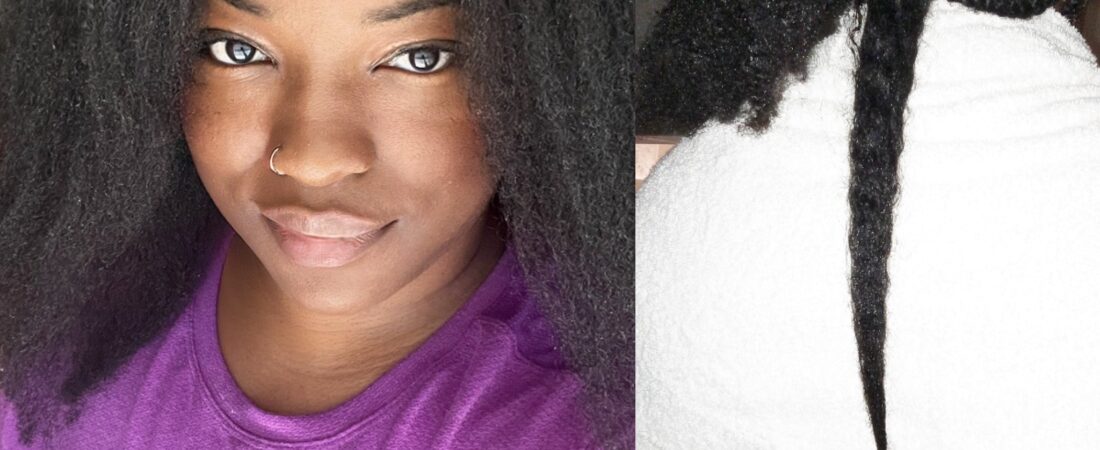
If growing long, healthy natural hair is your goal, one of the most important things to understand is length retention.
Your hair may be growing from the scalp every month, but if the ends are constantly breaking, splitting or being damaged, you may not see much difference in your overall length.
Think about it like pouring water into a basket.
You can continue adding water, but if it keeps escaping through the bottom, the basket will never stay full.
Hair growth and length retention work in a similar way.
Your hair can grow, but if you are losing close to the same amount through breakage, your hair may continue to appear as though it is not getting longer.
Hair Growth and Length Retention Are Not the Same Thing
Hair growth happens at the scalp.
Length retention is how much of that growth you are able to keep.
That distinction matters.
Some women naturally prefer short, healthy hair, and there is absolutely nothing wrong with that.
But if your goal is longer natural hair, focusing only on products that promise faster growth may cause you to overlook what is happening to the hair you already have.
Your question should not only be:
“How can I make my hair grow?”
It should also be:
“How can I keep the hair that grows?”
That is where length retention becomes important.
Why Your Natural Hair May Be Growing but Still Looks the Same Length
Natural hair goes through regular manipulation.
You may be:
- Detangling
- Combing
- Brushing
- Braiding
- Installing extensions
- Taking down extensions
- Restyling
- Using heat
- Trimming
- Manipulating your edges
- Handling your hair throughout the week
None of these things automatically means your hair will break.
The problem is excessive or rough manipulation, especially when the hair is dry, tangled or already fragile.
Over time, repeated breakage can make it difficult to retain your new growth.
This can be especially noticeable with fine strands, which may be less forgiving of repeated tension and rough handling.
If You Want Longer Hair, Protect the Length You Already Have
You cannot control every factor involved in hair growth.
But you can become more intentional about how you treat the hair that has already grown.
The goal is simple:
Reduce unnecessary breakage so you can retain more length over time.
Here are several ways to do that.
1. Pre-Poo Before Shampooing
A pre-poo treatment is used before shampooing to help prepare the hair for wash day.
This can be especially useful if your hair tends to feel dry or tangled before cleansing.
You can use water or a water-based moisturizer alongside a suitable oil to help soften the hair before detangling and shampooing.
At Zapi Beauty, we recommend Zapi Hair Growth Oil as part of a moisturizing pre-poo routine.
You may also pair your oil with water or aloe-based moisture, depending on what works well for your hair.
The goal is not to drown the hair in oil.
The goal is to make the strands softer and easier to handle before washing.
2. Moisturize First, Then Seal
Oil does not replace water.
If your hair is dry, adding oil alone may make it feel coated without providing the moisture it needs.
Start with moisture, then use an appropriate oil or butter to help slow moisture loss.
Your hair’s needs may vary depending on its texture, porosity, density and environment.
For women who like sealing their hair after moisturizing, Zapi Hair Seal & Shine can be incorporated as the finishing step.
Think of it this way:
Moisture first. Seal second.
3. Give Your Hair a Break From Constant Styling
Natural hair does not have to be restyled every few days.
If your goal is length retention for natural hair, reducing unnecessary manipulation can make your routine much gentler.
Try wearing styles that allow your hair to remain relatively undisturbed for longer periods.
This could include:
- Loose twists
- Braids without extensions
- Flat twists
- Tucked styles
- Buns that are not excessively tight
- Other low-manipulation hairstyles
The point is not to completely ignore your hair for a month.
It is to reduce unnecessary combing, restyling and pulling.
4. Do Not Depend on Extensions All the Time
Protective styles can be useful.
But simply installing extensions does not automatically make a hairstyle protective.
Heavy extensions, tight braids, repeated installations or excessive tension can work against your length-retention goals.
Give your natural hair periods where it can rest without additional extension weight.
When you do wear extensions, your scalp and hair should not feel painfully tight.
Protective styling should actually protect your hair.
5. Detangle Your Natural Hair in Sections
Detangling your entire head at once can make the process harder than necessary.
Instead, divide your hair into manageable sections.
Work gently from the ends upward rather than aggressively pulling through knots from the roots.
Take your time.
When you encounter a knot, do not treat your comb like it is in a fight with your hair.
Your goal is to separate the strands while preserving as many of them as possible.
For someone focused on length retention, gentle detangling matters.
6. Protect Your Hair While You Sleep
Your nighttime routine can affect how your hair feels in the morning.
A satin or silk bonnet can help reduce friction between your hair and your bedding.
You can also use a silk or satin pillowcase as an additional option.
This becomes especially important for your ends because the ends of your hair are the oldest part of the strand.
They have already survived months or years of washing, styling, weather, friction and manipulation.
Treat them accordingly.
7. Moisturize Before Braiding or Installing Extensions
Do not hide dry, neglected hair underneath a protective style and expect the style itself to solve the problem.
Before braiding or installing extensions, make sure your natural hair has been properly cleansed, conditioned and moisturized.
Pay particular attention to your ends.
Once the hair is braided underneath a wig or extension style, it may become easier to forget about it.
Your natural hair still needs care underneath the style.
Fine Natural Hair May Need an Even Gentler Routine
Not every person’s hair can tolerate the same amount of manipulation.
Someone with thicker individual strands may be able to comb and restyle frequently without noticing much breakage.
Fine strands may respond differently.
If your hair breaks easily, your routine may need to involve:
- Less frequent manipulation
- Gentler detangling
- Lower-tension hairstyles
- Less heat
- Lighter products
- More attention to your ends
Do not copy someone’s entire routine simply because you have a similar curl pattern.
Curl pattern and strand thickness are not the same thing.
Two women can both have 4C hair and still require very different routines.
Be Careful With Trimming Too Frequently
Trimming can be useful when your ends are split, damaged or causing excessive tangling.
But trimming simply because another person says natural hair must be cut every month can work against a length goal.
You do not want to constantly remove healthy length you are trying to retain.
Trim when your hair actually needs it.
The goal is healthy ends — not trimming for the sake of trimming.
Length Retention Is About Consistency
There is rarely one magical product or technique responsible for long natural hair.
The small things you do repeatedly matter.
Handle your hair gently.
Keep it moisturized.
Protect your ends.
Avoid unnecessary tension.
Reduce excessive manipulation.
Pay attention to how your hair responds.
Then give your routine time.
You may not notice a dramatic difference in one week or one month.
But retaining a little more of your growth month after month can create a very different result over time.
Final Thoughts: Grow It, Then Keep It
If long natural hair is your goal, do not focus only on how quickly your hair grows.
Focus on keeping the growth you already have.
Because growing two inches means very little if repeated breakage causes you to lose most of those inches again.
A healthy hair routine should help you maintain moisture, reduce unnecessary manipulation, protect your ends and preserve more length.
Grow it.
Protect it.
And most importantly, retain it.