
You can buy beautiful hair.
Choose the perfect texture.
Spend hundreds of dollars.
And still dislike the wig for one very simple reason:
It does not fit your head.
A wig that is too large may shift, bunch at the back or make you rely heavily on clips and straps just to keep it in place.
A wig that is too small may feel tight, uncomfortable or sit differently from the way it was designed.
That is why wig cap size should not be an afterthought.
Before you choose the length, density or even the texture of your next wig, you should know one basic measurement:
the circumference of your head.
Let’s measure it properly.
First: What Is Wig Cap Size?
Wig cap size refers to the dimensions of the foundation the hair is constructed onto.
Most shoppers first encounter wig sizes as:
Petite
Small
Medium
Large
or Custom
The most commonly discussed measurement is your head circumference, but circumference alone does not tell the complete story.
Two women can both measure 22 inches around the head and still have different:
forehead-to-nape measurements,
ear-to-ear measurements,
crown shapes,
or head proportions.
That is why custom wig fitting can be different from simply choosing a size from a dropdown menu.
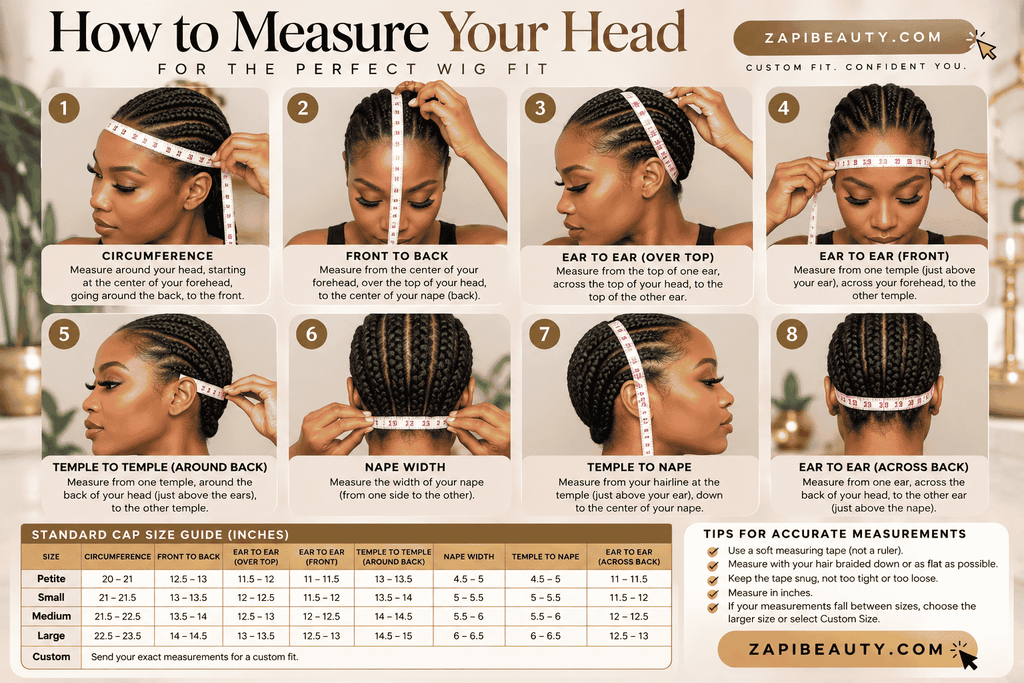
Zapi Beauty Wig Cap Size Guide
For Zapi Beauty wigs, use this as your starting point:
| Cap Size | Head Circumference |
|---|---|
| Petite | 20–21 inches |
| Small | 21–21.5 inches |
| Medium | 21.5–22.5 inches |
| Large | 22.5–23.5 inches |
| Custom Size | Made using your supplied measurements |
If your measurement sits right on the border between two sizes, don’t immediately assume the larger size is always safer.
There are other things we need to consider first.
How to Measure Your Head for a Wig
You need:
a soft measuring tape,
a mirror,
and your natural hair prepared as flat as you reasonably expect to wear it underneath your wig.
Do not measure over a large bun, thick braids or a bulky hairstyle unless that is genuinely how you intend to wear your hair underneath the wig.
Your foundation changes your measurement.
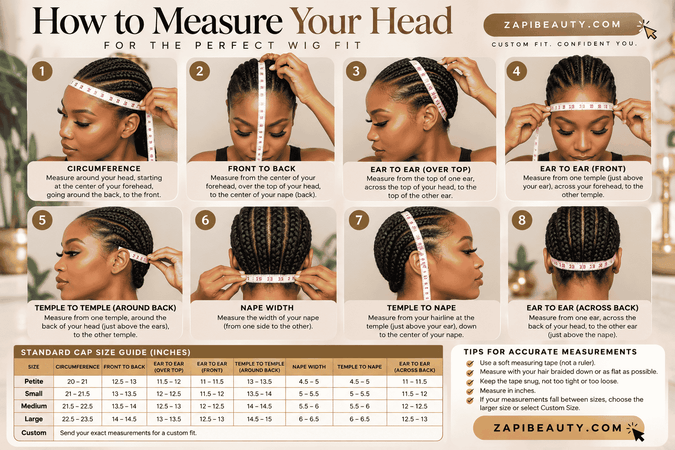
Measurement 1: Head Circumference
This is the measurement you should know even if you never take another one.
Start at the center of your front hairline.
Bring the measuring tape around:
behind one ear,
toward the nape,
behind the other ear,
and back to the center of the front hairline.
The tape should sit around the head where the edge of the wig cap will naturally sit.
It should be:
snug but not tight.
Do not pull the measuring tape so tightly that you’re reducing the measurement.
And don’t leave it hanging loosely either.
Write the number down.
Then measure it again.
Measure Twice
This sounds overly simple, but it prevents a lot of mistakes.
If you measured:
21.75 inches the first time
and
22.5 inches the second time,
something changed.
Do it again.
Your measurements should be reasonably consistent.
For a custom wig, guessing is not worth it.
Take your time.
Measurement 2: Front Hairline to Nape
Start at the center of your front hairline.
Run the tape over the top of your head, following the natural curve of your skull.
Continue down to the lowest point at the back where you want the wig to sit.
This is your front-to-nape measurement.
Why does it matter?
Because someone can have a normal circumference but a shorter or longer head from front to back.
If the cap is too long for your head, you may experience excess material or bunching around the nape.
Measurement 3: Ear to Ear Across the Forehead
Place the measuring tape near the top of one ear.
Bring it across the front of your hairline/forehead area to the same position near the other ear.
This helps determine the width across the front portion of the head.
For custom fitting, this can help create a cap that sits where it is supposed to rather than feeling excessively wide or narrow.
Measurement 4: Ear to Ear Over the Top
Now measure from one ear to the other again — but this time go over the crown of your head.
The tape should follow the shape of your head rather than floating above your hair.
This measurement tells us more about the width and shape of the crown.
Measurement 5: Temple to Temple Around the Back
Start near one temple.
Bring the tape around the back of your head to the opposite temple.
Again, keep the tape close to the head.
This helps identify the horizontal proportions toward the back of the cap.
Measurement 6: Nape Width
Measure across the lower back of your head from one side of the hairline at the nape to the other.
This is particularly helpful when creating a custom wig cap, because not everyone has the same width at the base of the head.
Your Measurements Should Look Like This
Save them somewhere.
For example:
Circumference: 21.75″
Front to nape: 13.5″
Ear to ear across forehead: 11.5″
Ear to ear over top: 12.5″
Temple to temple: 14″
Nape: 5″
Those are only examples.
Do not copy them as your measurements.
Measure your own head.
Here’s the Mistake I See People Make: Measuring Their Hair Instead of Their Head
Let’s say you have very dense 4C natural hair.
You put it into six chunky braids.
Then you measure your head over the braids.
Now the measuring tape isn’t really showing your head size.
It is showing:
your head + the bulk of your hairstyle.
Then you order a larger wig.
Later, you install the wig over a much flatter braid-down and suddenly the cap is too large.
For an accurate measurement, prepare your natural hair similarly to the way you expect to wear it underneath the wig.
You want to measure the foundation, not temporary volume.
What Does a Properly Fitting Wig Feel Like?
A well-fitting wig should feel:
secure, but not painfully tight.
You should not feel as though your scalp is being squeezed.
You also should not feel as though the entire wig could rotate around your head with very little resistance.
A good fit should allow the construction of the wig to do its job.
The combs, clips or elastic should help secure the unit.
They should not be compensating for a dramatically incorrect cap size.
Signs Your Wig Cap Is Too Big
This can be more obvious than people realize.
Your wig may be too large if:
it slides backward,
it shifts from side to side,
you have excessive material at the back,
the cap bunches around the nape,
you constantly tighten the adjustable straps to the maximum,
you rely heavily on clips to stop movement,
or the wig never seems to sit close to your head.
One particularly common sign is:
the cap fits at the front but creates a pouch of extra material at the back.
That can be a fit problem rather than a styling problem.
“My Wig Is Too Big. Can I Just Tighten the Elastic?”
Sometimes.
But there is a limit.
Elastic bands and adjustable straps are excellent for refining fit.
They should not turn a cap that is fundamentally too large into a completely different cap size.
If you’re pulling an elastic band extremely tight just to stop the wig from moving, you’ve traded one problem for another.
Now the wig may feel:
tight around one area,
while still being loose somewhere else.
A better-fitting cap distributes security more naturally.
Signs Your Wig Cap Is Too Small
A wig that is too small may:
feel tight around the perimeter,
ride upward,
put pressure on your temples,
fail to reach where it should at the nape,
feel uncomfortable after a short period,
or make the attachment points feel unusually tense.
And here’s something important:
A wig isn’t supposed to “hurt until it stretches.”
If your cap is significantly too small, simply tolerating discomfort is not a good fitting strategy.
Petite Wig Cap: Who Is It For?
At Zapi Beauty, a Petite cap corresponds to approximately 20–21 inches in circumference.
This can be particularly useful for women who constantly experience this problem:
“Every wig is too big for my head.”
If you’ve always tightened every wig to its smallest setting and still had excess material at the back, there’s a good chance you should actually be exploring wigs for small heads instead of assuming one-size-fits-all wigs are your only option.
A smaller cap can create a completely different experience.
Small Wig Cap
Our Small size covers approximately 21–21.5 inches.
That half inch may sound insignificant.
On a fitted wig cap, it matters.
Someone measuring 21 inches and someone measuring 22.5 inches do not necessarily need to be wearing the same cap.
This is one reason broad “average-size” caps work beautifully for some women and frustrate others.
Medium Wig Cap
The Medium range at Zapi Beauty is approximately 21.5–22.5 inches.
This accommodates many heads that fall within the more commonly produced commercial wig-size range.
But remember:
circumference is only part of the story.
A medium circumference does not automatically mean every medium cap construction from every company will fit you perfectly.
Brands cut and construct their caps differently.
Always check the actual size chart for the wig you are buying.
Large Wig Cap
Our Large cap fits approximately 22.5–23.5 inches in circumference.
And no, having a larger head measurement doesn’t mean you should have to squeeze into a standard cap because that is what happens to be available.
The entire purpose of offering different sizes is acknowledging that women’s heads are different.
The wig should accommodate the woman.
Not the other way around.
When Should You Choose a Custom Wig Cap?
This is where custom fitting becomes valuable.
Consider a custom wig cap if:
your circumference falls outside standard sizing,
your head proportions differ significantly from standard measurements,
you repeatedly experience excess cap material,
commercial wigs constantly feel too tight,
you have an unusual front-to-nape measurement,
or you simply want a unit constructed using your individual measurements.
Custom does not simply mean “expensive.”
It should mean:
made more specifically for you.
Custom Size Doesn’t Mean “Choose Whatever Number You Want”
There is an important responsibility on the customer’s side.
If a custom wig is made using the measurements you provide, those measurements need to be accurate.
If you accidentally add an inch because you were nervous about the wig being tight, the wig maker is now building a cap around a measurement that isn’t actually yours.
Likewise, don’t subtract an inch because you want the wig “extra secure.”
Measure accurately.
Let the cap construction handle the fit.
Should You Add Extra Inches to Your Wig Measurement?
Generally, do not randomly add inches unless the specific wig maker’s measuring instructions explicitly tell you to.
If your actual circumference is 21.5 inches, don’t automatically submit 22.5 because you’re worried the wig will be too tight.
You’re no longer giving your actual head measurement.
The same applies in reverse.
Don’t pull the tape tightly until your 22-inch head magically becomes 21 inches.
That defeats the purpose of measuring.
What If You’re Between Two Wig Sizes?
This deserves a more thoughtful answer than:
“Always size up.”
Suppose your circumference is right at the boundary.
Look at:
your other head measurements,
how your natural hair will be prepared underneath,
the adjustability of the wig,
the construction of the cap,
and the wig maker’s own sizing instructions.
If you’re ordering a Zapi Beauty custom unit and you’re unsure, use your actual measurements rather than trying to decide the cap size yourself.
That gives more useful information than simply saying:
“I think I’m medium.”
Your Braid-Down Changes the Fit
This is especially relevant for women with dense natural hair.
Imagine your wig fits beautifully over:
eight flat cornrows.
Then one day you install it over:
four very thick braids.
The wig may suddenly feel tighter.
Nothing happened to the cap.
Your foundation changed.
Likewise, if you measure your head with an extremely flat foundation and then wear bulky braids underneath, the finished fit will change.
Consistency matters.
Density and Cap Size Are Not the Same Thing
This connects directly to Blog 7.
Density = how much hair is on the wig.
Cap size = how the wig fits your head.
A 250% density wig doesn’t automatically require a larger cap.
A 180% density wig doesn’t automatically mean a smaller cap.
You could have:
a Petite 250% wig
or
a Large 180% wig.
These measurements are describing completely different aspects of the unit.
[INTERNAL LINK: 180% vs 250% Wig Density — How to Choose the Right Density]
Texture Doesn’t Determine Cap Size Either
Having 4C hair doesn’t mean you automatically need a larger cap.
Having fine hair doesn’t mean you need a petite cap.
The important factor is your actual head measurement with your natural hair prepared appropriately underneath.
Texture may influence how flat or bulky your foundation becomes, but it does not determine the circumference of your skull.
Measure.
Don’t guess based on your hair type.
Does Wig Length Affect Cap Size?
No.
A 12-inch wig and a 24-inch wig can use the same cap size.
Length affects the hair.
Cap size affects fit.
However, longer and denser wigs can weigh more, so having a properly fitted cap can become especially important when you’re wearing substantial amounts of hair.
You don’t want the weight of the wig constantly shifting an oversized cap.
Why Fit Matters Even More With Glue-Free Wigs
This is important for Zapi Beauty.
With a glue-free wig, the fit of the cap becomes part of the security system.
If the cap is significantly too large, you may find yourself depending on:
more clips,
more combs,
tighter elastic,
and more adjustment
just to keep the unit stable.
A better fit allows all those features to assist the wig rather than rescue it.
That’s particularly important for U-Part, V-Part and half-wig constructions.
Glue-Free Wigs for Natural Hair — U-Part, V-Part & Half Wigs Explained
The Clip Should Not Be Doing the Cap’s Job
Here’s a good way to think about it.
A clip is there to help secure the wig.
It is not supposed to drag an oversized cap into position.
If you constantly have to clamp clips tightly into your natural hair because the wig itself moves around too much, investigate the fit.
Sometimes people blame clips for discomfort when the underlying problem is actually the wrong cap size.
Your Wig Should Sit With You — Not Fight You
One of the goals of a custom fit is reducing how much you have to “manage” the wig while wearing it.
You shouldn’t spend your day:
pulling it forward,
pushing it backward,
readjusting the sides,
or checking whether the nape has bunched up.
The best wig fit becomes almost boring.
You put it on.
You secure it.
You style it.
Then you stop thinking about the cap.
That’s exactly what you want.
Wig Cap Size Checklist
Before ordering your next wig, confirm:
My natural hair is prepared similarly to how I will wear it under the wig.
I used a soft measuring tape.
I measured my circumference at least twice.
I didn’t pull the tape excessively tight.
I didn’t add random extra inches “just in case.”
I checked the specific company’s size chart.
For a custom unit, I took all requested measurements.
I wrote the measurements down instead of relying on memory.
That’s already better than simply clicking “Medium” because medium sounds average.
Frequently Asked Questions About Wig Cap Sizes
How do I know my wig cap size?
Measure your head circumference with a soft measuring tape, starting at the front hairline and wrapping around the ears and nape before returning to the starting point. Compare that number with the specific brand’s wig-size chart.
What is the average wig cap size?
Many commercial wig brands consider roughly the 21.5–22.5-inch range to be around average/medium, although sizing conventions can differ. Always use the individual company’s measurements rather than assuming all “Medium” wigs are identical.
How do I measure my head for a wig?
The most important measurement is circumference. Custom wigs may also require front-to-nape, ear-to-ear, temple-to-temple and nape measurements.
Should I measure my head with my hair braided?
You can, but your hair should be prepared as similarly as possible to how you plan to wear it underneath your wig. Avoid measuring over unnecessarily bulky braids.
What wig size is 21 inches?
At Zapi Beauty, approximately 20–21 inches falls within Petite, while 21–21.5 inches is within our Small cap range. Follow the size chart for the specific company you’re ordering from.
What wig size is 22 inches?
At Zapi Beauty, 22 inches falls within our Medium, approximately 21.5–22.5 inches.
What wig size is 23 inches?
At Zapi Beauty, 23 inches falls within our Large, approximately 22.5–23.5 inches.
Why does my wig bunch up at the back?
One possible reason is that the wig cap is too large or too long for your head. Bulky natural-hair preparation underneath can also affect how the cap sits.
Can I make a wig that is too big smaller?
Adjustable straps and elastic can help refine fit, and some wigs can be professionally resized. But if the cap is substantially too large, tightening straps may not correct every proportion of the cap.
Are custom-size wigs better?
Not automatically. Hair quality and construction still matter. But custom sizing can be especially useful for women whose head measurements or proportions don’t fit comfortably into standard commercial wig sizes.
Stop Asking Your Head to Fit the Wig
We spend a lot of time choosing:
the curl,
the length,
the density,
the color.
But all of that beautiful hair is sitting on a cap.
And if that cap doesn’t fit, you’re going to notice it every single time you wear the wig.
At Zapi Beauty, fit is not treated as an afterthought.
Our standard cap options include:
Petite: 20–21 inches
Small: 21–21.5 inches
Medium: 21.5–22.5 inches
Large: 22.5–23.5 inches
plus Custom Size for women who need something more individualized.
Because a premium wig shouldn’t only look beautiful.
It should feel like it was meant to be on your head.